Yamamoto Machinery Co.
Yamato Protec Table Feeder
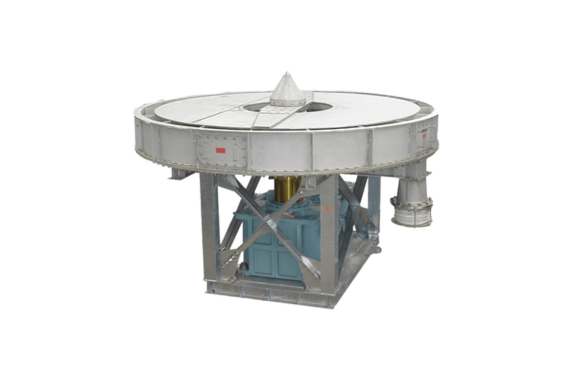
Manufacturer: Yamato Protec Corporation
This is a quantitative continuous discharge machine for powders and granules, an indispensable tool in powder processing plants . It is ideal for discharging difficult-to-discharge powders and granules such as various raw materials for compound feed and fertilizers (wheat bran, fish meal, rice bran, salt, extract residue, etc.) without causing bridging or separation.
- A table feeder with the same diameter as the tank can be installed.
- Two discharge ports can be installed on a single table feeder.
- Can be used as a feeder on a weighing machine.
- Supply accuracy can be ensured by using a screw feeder or cut gate.
- Remote control can be performed smoothly as there is no interruption in supply.
- Powder and granular mixed products can be shipped without separation or uneven distribution.
- Conventional tanks can also be modified and installed.
Comparison of discharge rates between table feeders and conventional tanks.
Problem 1: Separation phenomenon
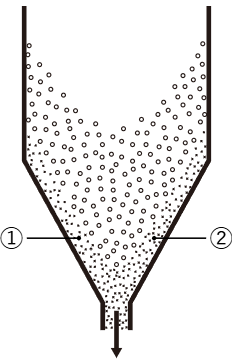
Conventional tanks have a discharge port in the center, so when storing mixed powders and granules, the powders that are relatively easy to discharge tend to be discharged first, while the other powders tend to lag behind. This separation phenomenon results in a problem where a large amount of powder remains in ① and ②.
Table feeder tank
Problem 2: Bridge phenomenon
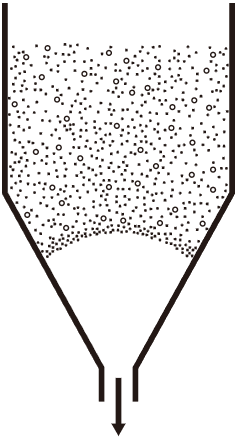
The powdered material introduced from the transport equipment is somewhat warm, and in conventional tanks, the powdered material tends to solidify over time. This makes it prone to bridging, which makes discharge difficult.
When using a table feeder, powders and granules are discharged simultaneously from two points: a 360° radius around the table feeder and a central point. The powders and granules in the tank are reduced in volume while maintaining a horizontal state, similar to a liquid. The circumferential discharge structure prevents bridging, which can occur due to the collapse of bridge girders. Furthermore, the constant low-speed rotation prevents separation of the mixed powders and granules.
Various Table Feeders/ TABLE FEEDER
Table feeder
It is effective in preventing bridge separation. If a quantitative feeding function is required, a quantitative feeder will be needed after the discharge port. The shape of the gearbox can be selected from various types.
Emissions
Feed, fertilizer, and pet food ingredients / Compound feed product types / Rapeseed / Wheat bran / Salt / Coffee grounds / Tea grounds / Soy sauce residue / Dried sludge / Wood chips / Shredded film / Plastic pellets
Size
Φ600 to Φ3,000 (internal tank dimensions)
Micro Table Feeder
It is effective in preventing bridging. It can be used as a quantitative feeder on a weighing machine.
Size
Φ300~Φ500 (internal tank dimensions)
Ability
40L/Hr~
Large silo discharge system
By combining a table feeder and a high-pressure air supply, we successfully discharged soybean meal from a large silo (φ6700) at a hopper angle of 45°. A utility model patent has been obtained. [Registration No. 32555165]
Single-tier table feeder
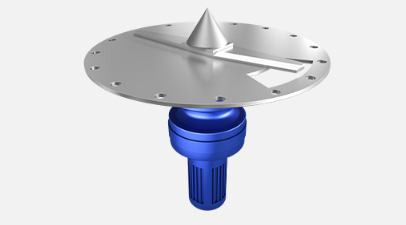
It is effective in preventing bridging. Its simple structure makes cleaning easy. If a quantitative feeding function is required, a quantitative feeder will be needed after the discharge port. The shape of the gearbox can be selected from various types.
Size
Φ600 to Φ2,000 (internal tank dimensions)
Related Products


REQUEST QUOTATION

PAYMENT

LINK