KOKEN LTD.
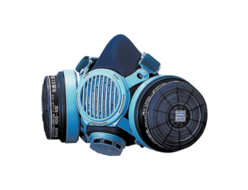
Koken 1180H Dust Mask
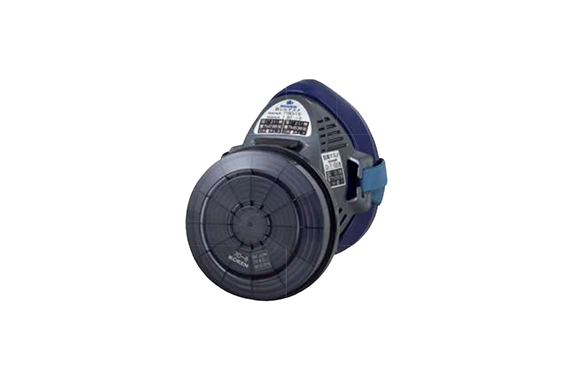
Manufacturer: KOKEN LTD.
Model: 1180H
Important points when wearing a mask
Dust masks utilize high-efficiency filters to effectively prevent the inhalation of hazardous particles. To protect yourself from inhaling dust while wearing a mask, the performance of the filter and the “tight seal” (fit) between the mask and your face are critical.
1. Filter Technology with High Particle Collection Efficiency
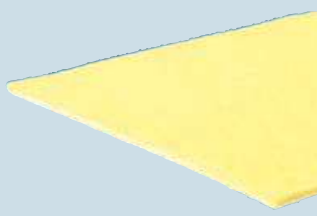
Mighty (Uni) Micron Filter
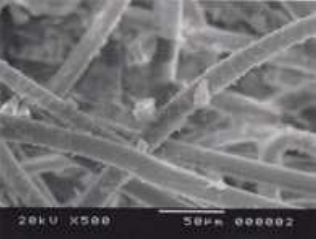
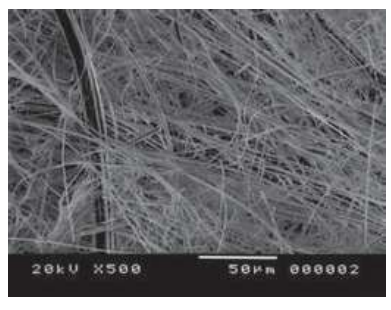
Using unique technology, wool fibers are electrostatically charged, allowing electrostatic force to draw particles to the fiber surface. This is the primary mechanism for capturing particles. A high-density fiber structure is unnecessary, successfully integrating the two contrasting features: “high collection efficiency” and “low inhalation resistance.” It consistently maintains the highest standard of performance and quality, making it an excellent long-term filter solution.
 |  |
Applied products are on P.4 ~ 6, P.11
Alpha Ring Filter
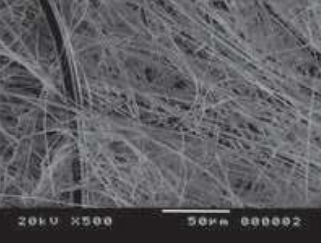
Increasing the fiber density of the filter enhances collection efficiency. To meet airflow resistance standards, paper filters traditionally require an expanded surface area.
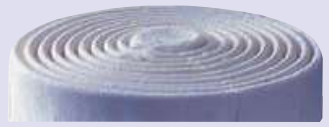
For the first time in Japan, ultra-fine fibers were formed into pristine circular shapes in a single process, creating the Alpha Ring filter. Today, this filter continues to succeed in expanding the surface area while maintaining a compact shape, significantly reducing airflow resistance.
 |  |
Applied products are from page P.8 to P.11
Dust Respirator Standards
In addition to JIS standards, dust respirators are tested according to assay standards based on national regulations. These standards are comprehensive, ensuring that products meeting strict safety requirements are manufactured.
| Dust Respirator Standards | In addition to JIS standards, dust respirators are tested according to assay standards based on national regulations. These standards are comprehensive, ensuring that products meeting strict safety requirements are manufactured. |
|---|
Note: The table below is excerpted from the “Dust Respirator Standards”.
| Replaceable Dust Respirator | Isolation Type Dust Respirator |
|---|---|
| Direct-Connection Type Dust Respirator | |
| Disposable Dust Respirator | |
| Test Particles | Type | NaCl (Sodium Chloride) | DOP (Dioctyl Phthalate) | ||
|---|---|---|---|---|---|
| Particle Size | 0.06 μm to 0.1 μm | 0.15 μm to 0.25 μm | |||
| Concentration | 50mg/m³ or less | 100mg/m³ or less | |||
| Test Flow Rate | 85 ℓ /min | 85 ℓ /min | |||
| Particle Collection Efficiency (Continuous measurement; must meet values in the right column) | For NaCl particles Load up to 100mg | For DOP particles Load up to 200mg | |||
| Replaceable Type | RS1 | 80.0% or higher | RL1 | 80.0% or higher | |
| RS2 | 95.0% or higher | RL2 | 95.0% or higher | ||
| RS3 | 99.9% or higher | RL3 | 99.9% or higher | ||
| Disposable Type | DS1 | 80.0% or higher | DL1 | 80.0% or higher | |
| DS2 | 95.0% or higher | DL2 | 95.0% or higher | ||
| DS3 | 99.9% or higher | DL3 | 99.9% or higher | ||
| Inhalation Resistance (Test flow rate 40 ℓ /min) | Replaceable Type | Disposable Type | |||
| RS1 RL1 | 70Pa or less | DS1 DL1 | 60Pa or less (45Pa or less) | ||
| RS2 RL2 | 80Pa or less | DS2 DL2 | 70Pa or less (50Pa or less) | ||
| RS3 RL3 | 160Pa or less | DS3 DL3 | 150Pa or less (100Pa or less) | ||
| Exhalation Resistance (Test flow rate 40 ℓ /min) | Replaceable Type | Disposable Type | |||
| RS1 RL1 | 70Pa or less | DS1 DL1 | 60Pa or less (45Pa or less) | ||
| RS2 RL2 | 70Pa or less | DS2 DL2 | 70Pa or less (50Pa or less) | ||
| RS3 RL3 | 80Pa or less | DS3 DL3 | 80Pa or less (100Pa or less) | ||
Values in ( ) are for products without an exhalation valve.
| Exhalation Valve Airtightness | Exhalation valve leak test | – Internal pressure must drop immediately during suction. – Time for internal pressure to return to normal must be 15 seconds or more. |
|---|---|---|
| CO2 Concentration Increase | Measured using a test headform and artificial lung. The difference in CO2 concentration in inhaled air with and without the mask must be 1.0% or less. | |
| Dead Space | Value calculated from the CO2 Concentration Increase Test. | |
| Inhalation Resistance Increase | Test Particles | NaCl (Sodium Chloride) |
|---|---|---|
| Test Flow Rate | After dust accumulation at 85 ℓ/min, measurement is taken at 40 ℓ/min. | |
| Dust Accumulation Amount | 100mg |
Test Particles & Efficiency Disposable / Replaceable | S | L | Classification (Efficiency) | |
|---|---|---|---|---|
| Test particle: Solid NaCl | Test particle: Liquid DOP | |||
| R | Replaceable Dust Respirator | RS1 | RL1 | Class 1 (≥ 80.0%) |
| RS2 | RL2 | Class 2 (≥ 95.0%) | ||
| RS3 | RL3 | Class 3 (≥ 99.9%) | ||
| D | Disposable Dust Respirator | DS1 | DL1 | Class 1 (≥ 80.0%) |
| DS2 | DL2 | Class 2 (≥ 95.0%) | ||
| DS3 | DL3 | Class 3 (≥ 99.9%) | ||
High Efficiency Filter + Face-Friendly Surface
2. Surface Engineering for a Better Facial Fit
Even if a dust mask has a high collection efficiency filter, it is useless if dust leaks in through the facepiece seal. The primary cause of leakage is the “gap at the contact area when wearing the mask.” We consider the fit of the mask to be as important as the filter performance. Therefore, our company has developed technology to enhance the airtightness of the facial contact area.
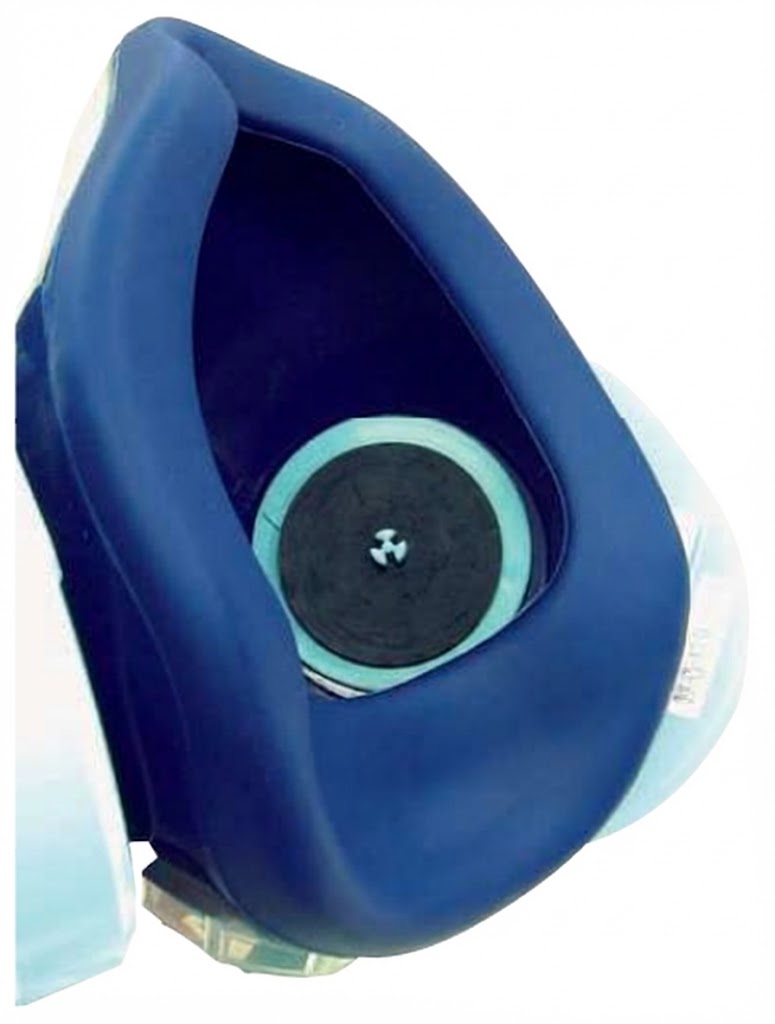 Silicone Facepiece
Silicone is a hypoallergenic material that is gentle on the skin. Its surface is flexible and easily adapts to body movements, ensuring wearing comfort and stability during use.
HAWC harness strap
The strap design ensures a high level of fit, maximizing the “suction” effect when wearing the mask to ensure an airtight seal on the face.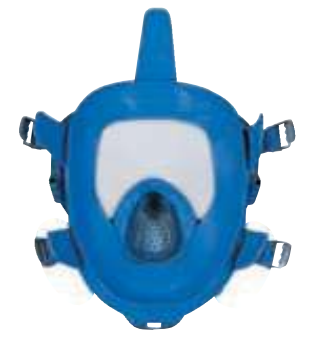
Freeposition Underchin
The special shape of the facial contact area prevents dust entry. The nose section is adjustable for different sizes, ensuring a perfect fit for a wide range of facial dimensions (see image below).
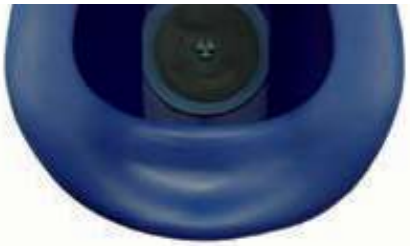
Fit Status of the Freeposition Underchin Facepiece
(Cross-sectional simulation to show the contact position between the mask and the chin).
| For large faces: Uses the outer section of the mask to adjust the fit around the chin. | 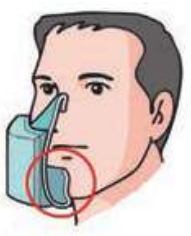 | For small faces: Uses the inner section of the mask to adjust the fit around the chin. | 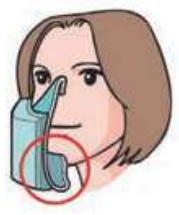 |
| FF Lip | Wearing Safety | Internal Fit Checker | |||
|---|---|---|---|---|---|
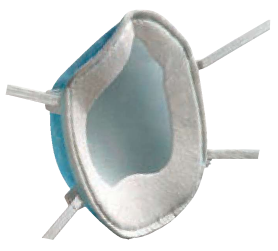 | Designed for various face shapes; the cushion naturally fits your face. | 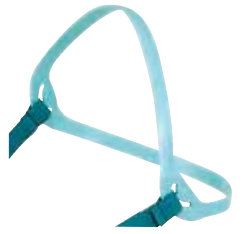 | Utilizes a 3D poly-band harness that matches head shapes to enhance the feeling of fit and seal. | 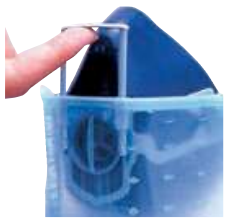 | Fit checker is integrated inside, helping to check the mask seal at any time (for 1005, 1010A, 1015, 1180 series). |
Replaceable Dust Respirator – Alpha Ring Filter
Alpha Ring Filter with concentric design and compact shape
Paper filters that enhance particle collection efficiency by increasing fiber density often require an expanded surface area to meet airflow resistance standards.
The Alpha Ring filter was the first domestically developed filter using ultra-fine fibers molded into a round pleat structure.
Currently, by continuing to expand the filtration surface area, the filter maintains a compact shape while achieving lower breathing resistance, resulting in higher and more stable performance.
All Alpha Ring filters are water-repellent treated
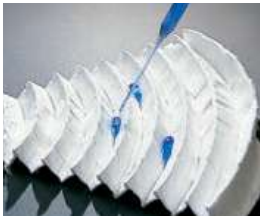
The filter is treated for water repellency to limit the adherence of mist or droplets, ensuring breathing remains easy during use.
Additionally, this treatment is effective against oil mist.
HAWC Lip (High Adaptable Wide Concave)

The facial contact area has a wide concave surface that surrounds the face. When the harness is tightened, a suction effect is created, resulting in high airtightness.
*HAWC stands for High Adaptable Wide Concave.
*Image shown is the Model 1021H.
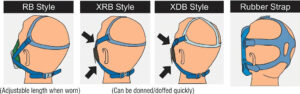
(Head Harness Types)
Please replace head straps periodically.
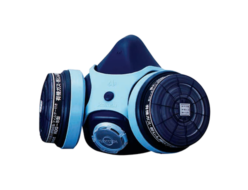
Sakai Model 1180H
The company’s basic RL3 model – lightweight at only 114 g
Built-in seal check lever (Fit Checker)
Size S available
RL3 Rating
Model Assay Certificate: TM788
Assigned Protection Factor: 10
Can be used as a gas mask with G-7 configuration
(Absorbent canisters sold separately)
Gas Mask Certificate: TN382
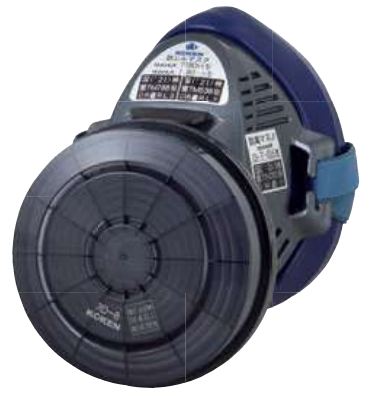
- Fit Checker (Integrated seal test lever)
- Under-Chin Ergonomics
- Silicone Seal
- Size S available
| Particle Collection Efficiency | 99.9% or higher (Average 99.99%) |
|---|---|
| Inhalation Resistance | 88Pa or less (Average 69Pa) |
| Exhalation Resistance | 45Pa or less (Average 30Pa) |
| Inhalation Resistance Increase | ― (Average 89Pa) |
| Weight | 134g or less (Average 114g) |
| Harness | RB Type |
Option: Moisture Sponge Type A
Replacement Parts:
- Inhalation Valve: Small 03 type
- Exhalation Valve: T-7 type
Notes on Filter Replacement
As dust accumulates in the filter, breathing resistance increases, making respiration more difficult.
Furthermore, besides difficult breathing, if the mask does not fit perfectly against the face, dust can bypass the filter through any gaps.
- Always perform a seal check before use and ensure the mask is firmly secured to your face.
- Replace the filter before breathing becomes difficult to prevent excessive resistance buildup.
*If you have any questions regarding replacement, please contact our office or local distributor.
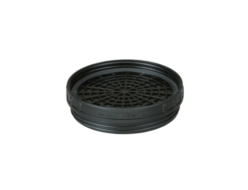
Replacement Filters · Optional Accessories
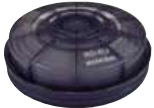
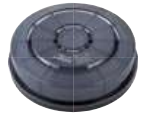
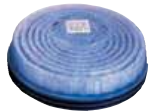
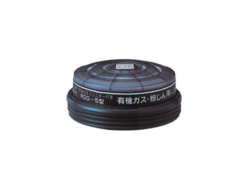
| RD-6 (for: 1721H, 1521H, 7121R, 7191DK) | RD-6U (for: 7191DKU, 1521U) | RD-8 (for: 1180H) | LAS-52 (for: 1781DW) | LAS-52C (for: 1781DWC) | (Optional) Fit Test Device – Type V Applied to models: 1721H, 1521H, 1521U, 7121R, 7191DK, 7191DKU | (Optional) Fit Test Device – Type F Applied to models: 1781DW, 1781DWC |
 |  |  |  |  | 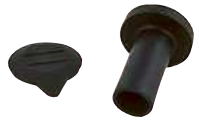 | 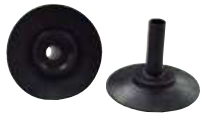 |
| 2 pcs/set — screw connection | 2 pcs/set — screw connection | screw connection | 2 pcs/set — screw connection | 2 pcs/set — screw connection |
- Fit Checker: Simply pull the lever to perform a user seal test.
- Under-Chin: Unique curved shape enhances the seal between face and mask.
- Silicone: Soft, skin-friendly material; silicone seal provides a comfortable fit.
- HAWC Lip: Achieves high airtightness via “suction effect”; applied to full-face models.
- Size S available: Smaller size for individuals with petite faces.
- Low breathing resistance: Uses Alpha Ring filters for reduced breathing effort during long-term use.
- Speaking Diaphragm: Facilitates clear communication and verbal instructions without mask removal.
- Activated Carbon: Simultaneously removes low-concentration ozone; utilizes carbon-impregnated filters.
- Surface Hardening: Visor surface is treated to resist scratches.
- Special Surface Hardening: Enhanced scratch protection compared to standard hardening treatments.
Note: Consumable components and filters should be replaced early and on schedule.
Would you like me to explain the differences between the RL2 and RL3 classifications mentioned in this document?
REQUEST QUOTATION

PAYMENT

LINK