KOKEN LTD.
Koken R-5X-08 Gas Mask
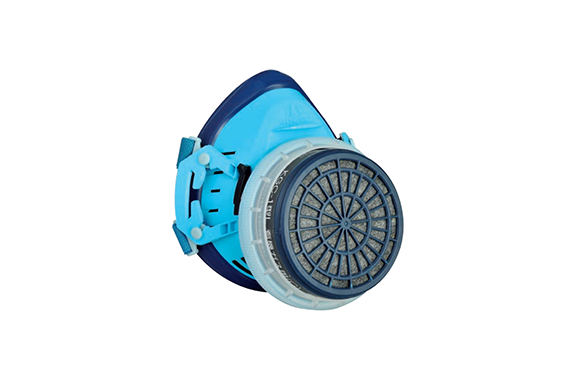
Manufacturer: KOKEN LTD.
Model: R-5X-08
Proper Selection and Use of Gas Respirators
When using a gas respirator, it is necessary to fully understand the hazard level of the substances involved, and the selection, wearing, and management of the filter cartridge or mask must match the type and concentration of the toxic gas. Additionally, please use gas respirators with performance specified by the National Assay Standards under the Industrial Safety and Health Law or Japanese Industrial Standards (JIS T 8152).
Correct Selection
■ Environments where gas respirators cannot be used
If any of the following conditions apply, please do not use a gas respirator. Please use protective equipment suitable for the environmental conditions, such as a supplied-air respirator or a self-contained breathing apparatus (SCBA).
- Oxygen-deficient environments or where there is a risk of oxygen deficiency.
- The type or concentration of the toxic gas is unknown.
- IDLH environments (Atmospheres Immediately Dangerous to Life or Health).
- The toxic gas concentration exceeds the maximum use concentration limit of the gas respirator.
- There is no filter cartridge available that can remove the toxic gas in that environment.
- There is a mixture of gases with different properties.
- The operating environment deviates significantly from normal temperature, normal humidity, and normal atmospheric pressure.
■ Selecting a gas respirator suitable for the toxic gas concentration
When selecting a gas respirator, after confirming the type and concentration of the hazardous substance, it is necessary to choose the appropriate respirator type as outlined in the notification “Regarding the Selection and Use of Dust Masks, Gas Respirators, and Powered Air-Purifying Respirators” (Issued in Reiwa 5 [2023], Document No. 0525-3).
STEP 1: Check if the concentration exceeds the usage limits of the gas respirator.
● Upper limits for using gas respirators according to the National Assay Standards:
| Type | Maximum Use Gas Concentration |
|---|---|
| Isolation Type | 2% or less (20,000 ppm or less) |
| Direct Connection Type | 1% or less (10,000 ppm or less) |
| Small Direct Connection Type | 0.1% or less (1,000 ppm or less) |
(*For Ammonia gas, the isolation type and direct connection type limits are 1.5 times the above figures)
-> DOES NOT EXCEED (Proceed to Step 2)
(If the concentration is within the table above)
STEP 2: Calculate the “Required Protection Factor,” then select a gas respirator with an “Assigned Protection Factor” higher than that value.
Formula 1: How to calculate the Required Protection Factor
Required Protection Factor = Ambient concentration of the hazardous substance ÷ Permissible exposure limit of the hazardous substance
After calculating, select the appropriate mask type based on the results below:
CASE A: Required Protection Factor is 50 OR MORE
Must use: Powered air-purifying respirator (PAPR) for toxic gases or Supplied-air respiratory protective equipment.
CASE B: Required Protection Factor is UNDER 50
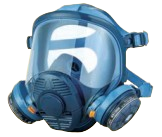
Recommended: Full-face gas respirator.
(Assigned Protection Factor: 50)
CASE C: Required Protection Factor is UNDER 10
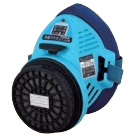
Recommended: Half-face gas respirator.
(Assigned Protection Factor: 10)
-> EXCEEDS (Branch right from Step 1)
(If the concentration is higher than the table in Step 1)
Must use: Supplied-air respiratory protective equipment
(e.g., Airline mask, Self-Contained Breathing Apparatus (SCBA), etc.)
◎ In cases where occupational safety and health laws specify the type of respiratory protective equipment to be used or the selection procedure, you must choose a mask that complies with those legal regulations.
■ Selecting the right filter cartridge for the toxic gas
According to the National Assay Standards, there are 5 types of filter cartridges specified (for Halogen gas, Organic gas, Carbon monoxide, Ammonia, SO2 gas) and a total of 10 types if counting those with integrated particulate filters. In addition, the Japanese Industrial Standards (JIS) specify other types not included in the above list, such as those for Acid gases, Hydrogen sulfide (H2S), etc. Please see page 10 for details.
※ Note: Please verify via the “breakthrough curve” graph to ensure the decontamination capacity of the cartridge has sufficient margin relative to the ambient concentration.
In environments mixed with dust, welding fumes, or mist: It is necessary to use a filter that meets the appropriate standards for that specific hazard (as shown in the table to the right – referenced in the original text).
● Particle Collection Efficiency and Classification
| Test Dust Type | NaCl (Sodium Chloride) – Solid Particles | DOP (Dioctyl Phthalate) – Liquid/Oil Particles | ||
|---|---|---|---|---|
| Particle Collection Efficiency | S1 | 80.0% or more | L1 | 80.0% or more |
| S2 | 95.0% or more | L2 | 95.0% or more | |
| S3 | 99.9% or more | L3 | 99.9% or more | |
● Example of choosing a gas respirator with a dust filter based on the dust type/work
| Dust Type / Work Name | No Oil Mist Present | Oil Mist Present |
|---|---|---|
| Work with a risk of exposure to highly toxic dust such as radioactive materials, Dioxins, etc. | S3, L3 | L3 |
| Work generating highly toxic dust | S3, L3, S2, L2 | L3, L2 |
| Work generating low toxicity dust | S3, L3, S2, L2, S1, L1 | L3, L2, L1 |
Proper Usage
For gas respirators, besides “Correctly selecting the mask and cartridge,” it is extremely important to “Wear the mask so that it seals tightly against the face.” If the mask does not fit the face and there is a gap at the contact area, toxic gases may leak in from there, rendering the mask useless. Koken’s masks utilize various technologies to ensure a tight fit with the face.
Facepiece Designed with a Focus on Fit
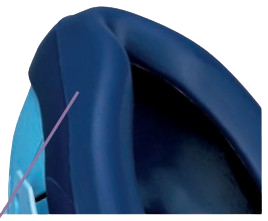
Free Position Under Chin Structure: The face contact part uses a facepiece with a unique curve. When worn, if you position the nose part first, the chin support is designed to automatically settle into the appropriate position regardless of facial size. Therefore, a single mask size can provide a good fit for almost everyone.
Silicone Facepiece: Silicone material is gentle on the skin and softly conforms to facial movements, providing a stable and comfortable wearing experience.
Headband with Excellent Stability
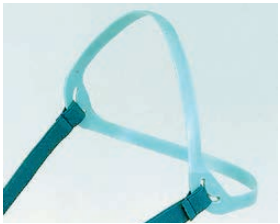
Utilizes a 3D-shaped plastic headband (poly-band), further improving the fit and seal when worn.
Speech Diaphragm
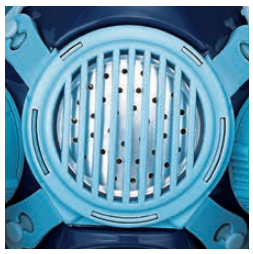
Thanks to the speech diaphragm located in the center of the mask, users can converse or give instructions even while wearing the mask.
This speech diaphragm does not use any batteries or power sources, so there is no risk of explosion even in environments with flammable gases.
HAWC Lip Facepiece
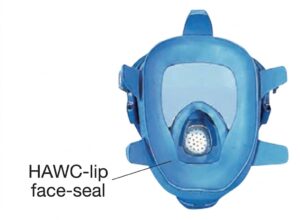
The product utilizes the “HAWC lip※” facepiece design with a special curve and a wide, flexible lip, creating our company’s unique suction cup effect. This achieves high airtightness, a wide field of vision, and lightweight design.
※ Stands for: High Adaptable Wide Concave.
Always perform a Seal Check (Fit Check)
To verify that the mask is tightly sealed against the face before starting work, it is essential to confirm the fit, in other words, to perform a “Seal Check” prior to beginning any tasks.
If you seal the inhalation port while the mask is worn correctly and is airtight, air will not enter the mask from anywhere when you inhale. This method of confirming no leaks by actively inhaling is called the “Negative pressure seal check method.”
The Ministry of Health, Labour and Welfare’s notification “Regarding the Selection and Use of Dust Masks, Gas Respirators, and Powered Air-Purifying Respirators” (Document No. 0525-3, dated May 25, Reiwa 5 [2023]) outlines the following. (The following is a partial excerpt from the notification)
(3) Performing a seal check
The seal check must be performed in accordance with the instructions provided in the user manual of the air-purifying respiratory protective equipment (for powered air-purifying respirators, this applies only to tight-fitting facepiece types). (Middle section omitted)
(a) Negative pressure seal check method: Use a fit checker or similar object to block the inhalation port, taking care not to press the mask strongly against your face (if there is a connection tube, block the tube’s intake or pinch the tube to block it). Inhale slowly, and verify that air does not enter the mask from the gap between the mask and the face, and that the mask is sucked tightly against the face. (Subsequent text omitted)
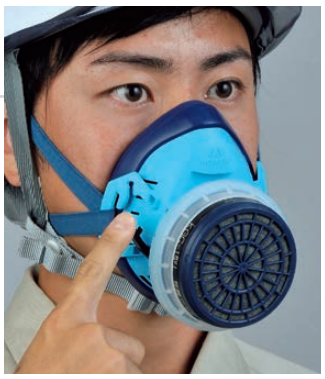
Sakai Type – Model R-5
Because a fit checker is built-in, you can easily perform the negative pressure seal check by simply pressing down on the lever.
Regarding Isolated Type Gas Respirators
Although the National Assay Standards specify a maximum gas concentration limit of 20,000 ppm for using isolation-type cartridges, our company recommends that in high-concentration environments exceeding 10,000 ppm, using respiratory protective equipment such as supplied-air respirators (airline masks) is more appropriate than gas respirators. Therefore, we do not manufacture isolated-type gas respirators.
Small Direct Connection Type Gas Respirator
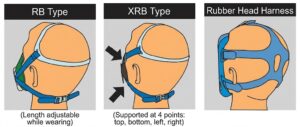
Headband classification: Please replace the headband periodically.
Scope of Application
Strictly use only when the following conditions are met.
- For small direct connection types: Permissible toxic gas concentration is 1,000 ppm (0.1%) or less.
- The required protection factor is lower than the assigned protection factor.
Various types of filter cartridges can be installed corresponding to diverse types of gases.
For the organic gas series, there are 3 types to choose from depending on usage time.
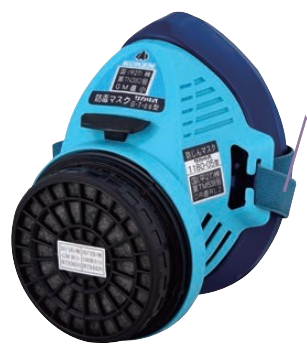
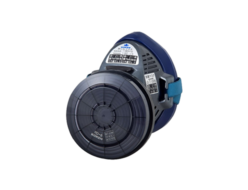
Sakai Type – Model R-5X-08
National Test Certification No.: TN422
Assigned Protection Factor: 10
Equipped with a built-in fit checker. Uses the same facepiece as Model R-5 but utilizes a 4-point headband providing excellent stability when worn.
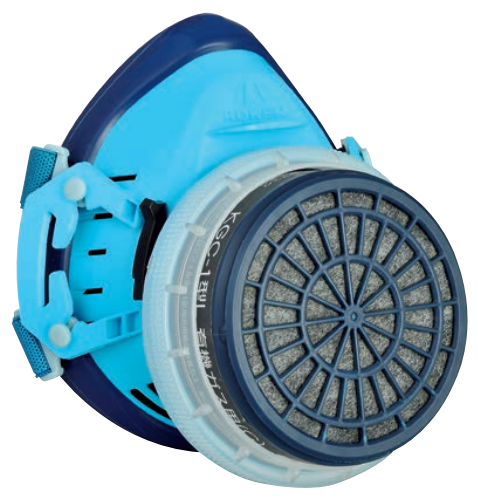
- Fit Check
- Under Chin
- Silicone
| Weight (Mask only) | 147g or less |
|---|---|
| Compatible Cartridges (sold separately) | KGC-1 Series, KGC-5MC Type |
| Headband | Type XRB |
Features:
- Fit Check: You can easily perform a fit test just by pulling up the lever.
- Under Chin: Enhances the facial seal through a unique curved design.
- Silicone: Soft wearing feel, skin-friendly. The facepiece uses silicone material.
- HAWC Lip: The full-face mask utilizes a HAWC lip to create a high-airtight seal via a “suction cup effect”.
- Size S Available: An S size is available for individuals with smaller faces.
- Speech Diaphragm: Allows for conversation or giving instructions while wearing the mask. The mask is equipped with a high-performance speech diaphragm.
- Surface Hardening: The lens surface is treated with a hardening process, making it resistant to scratches.
- Special Surface Hardening: Thanks to a special coating, scratch resistance is significantly improved compared to standard surface hardening methods.
- Bi-pro: An eco-friendly filter that recycles leftover materials from the die-cutting process.
REQUEST QUOTATION

PAYMENT

LINK