KOKEN LTD.
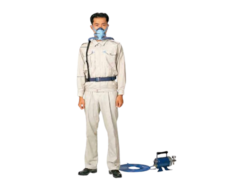
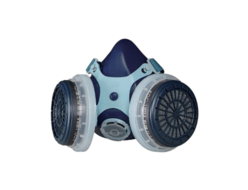
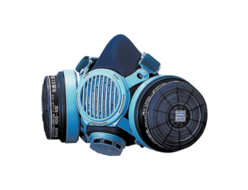
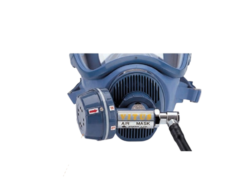
Koken BRDG-82 P-PAPR
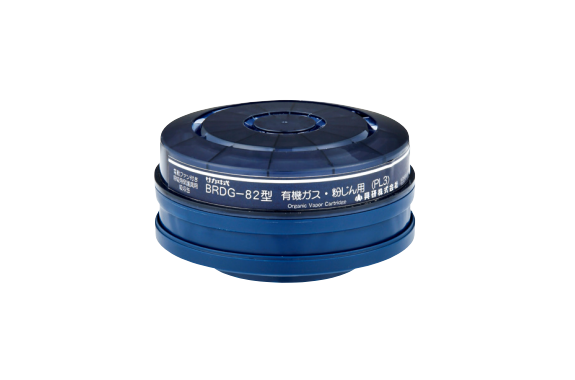
Manufacturer: KOKEN LTD.
Model: BRDG-82
P-PAPR: Powered Air-Purifying Particulate Respirator
PARTICULATE PAPR and GAS PAPR
- PAPR: Powered Air-Purifying Respirator.
- P-PAPR: Particle-PAPR (For dust/particulates).
- G-PAPR: Gas-PAPR (For toxic gases/vapors).
Within the PAPR lineup, there is the “Powered Air-Purifying Particulate Respirator (P-PAPR)” used for dust, and the “Powered Air-Purifying Gas Respirator (G-PAPR)” used for toxic gases. It is necessary to understand the properties, types, and concentrations of the hazardous substances before selecting the appropriate respirator.
To prevent inhalation of DUST -> Use a Powered Air-Purifying Particulate Respirator (P-PAPR)
To prevent inhalation of TOXIC GAS -> Use a Powered Air-Purifying Gas Respirator (G-PAPR)
To prevent inhalation of MIXED DUST & TOXIC GAS -> Use a Powered Air-Purifying Gas Respirator (G-PAPR) with dust protection function
Environments where PAPR CANNOT be used
If any of the following conditions apply, a PAPR must not be used. Please use protective respiratory equipment suitable for the environmental conditions, such as a supplied-air respirator or a self-contained breathing apparatus (SCBA).
- Oxygen-deficient environments or where there is a risk of oxygen deficiency (Oxygen concentration below 18%).
- Cases where the type or concentration of the toxic gas is unknown.
- Cases of IDLH environments (Atmospheres Immediately Dangerous to Life or Health).
- Cases where the toxic gas concentration exceeds the maximum use concentration limit of the PAPR. ※
- Cases where there is no filter cartridge available that can remove the toxic gas present in the environment.
- Cases where there is a mixture of gases with different properties.
- Cases where the operating environment deviates significantly from normal temperature, normal humidity, and normal atmospheric pressure.
(※ According to standards based on the Industrial Safety and Health Act, the application range for G-PAPR is 2% (3% for Ammonia))
SELECTING THE APPROPRIATE PAPR BASED ON HAZARDOUS SUBSTANCE CONCENTRATION
Determine the Required Protection Factor, then select a PAPR model with an Assigned Protection Factor higher than that value.
Formula: How to calculate the Required Protection Factor
Required Protection Factor = Ambient concentration of the hazardous substance / Permissible exposure limit of the hazardous substance
Assigned Protection Factor of P-PAPR
| Classification | Facepiece Type | ||||
|---|---|---|---|---|---|
| Inward Leakage Rate | Filter Efficiency | Half-face | Full-face | Hood Type | Face Shield Type |
| Class S | PL3/PS3 | 50/300 | 1000 | 25/1000 | 25/300 |
| PL2/PS2 | — | — | 20 | 20 | |
| PL1/PS1 | — | — | 11 | 11 | |
| Class A | PL3/PS3 | — | — | 20 | 20 |
| PL2/PS2 | 33 | 90 | 20 | 20 | |
| PL1/PS1 | 14 | 19 | 11 | 11 | |
| Class B | PL3/PS3 | — | — | 11 | 11 |
| PL2/PS2 | — | — | 11 | 11 | |
| PL1/PS1 | 14 | 19 | 11 | 11 | |
Assigned Protection Factor of G-PAPR
| Facepiece Type | |||
|---|---|---|---|
| Half-face | Full-face | Hood Type | Face Shield Type |
| 50/300 | 1000 | 25/1000 | 25/300 |
For a “G-PAPR with dust protection function”, please refer to the Assigned Protection Factor of P-PAPR (Class S inward leakage rate) mentioned above for the assigned protection factor against dust (and similar particulates).
WORK ENVIRONMENTS WHERE PAPR USE IS MANDATORY BY LAW OR DIRECTIVE
For tasks where the use of a PAPR is mandatory by law or directive, please use a PAPR with the designated performance classification.
1. Tunnel Construction Work
Law: “Ordinance on Prevention of Pneumoconiosis”
Target: In tunnel construction works, at locations involving “excavation by machine/power”, “loading or unloading of ores/rocks by machine”, and “shotcreting”.
PAPR Requirements:
- National test certified product (High airflow type).
- Tight-fitting facepiece type with a removable battery for use during blasting operations.
2. Asbestos Removal Work
Law: “Ordinance on Prevention of Health Impairment due to Asbestos”
Target: In asbestos removal tasks, work requiring “Class 1 Asbestos Removal Respirators”.
PAPR Requirements: National test certified product, tight-fitting and hood types (High airflow, Class S, PL3 or PS3).
3. Nanomaterial Handling Work
Directive: “Regarding Preventive Measures to Prevent Exposure to Nanomaterials”
Target: Manufacturing and handling of nanomaterials. (※)
PAPR Requirements:
- National test certified product (High airflow, PL3 or PS3).
- Shape limitations based on the expected worker exposure levels.
(※) Depending on the working environment, respiratory protective equipment other than PAPR may be permissible.
4. Indium Handling Work
Directive: “Regarding Thorough Measures to Prevent Health Impairment due to Indium/Tin Oxide Handling”
Target: Handling of indium, tin oxide, etc. (※)
PAPR Requirements:
- National test certified product (High airflow, PL3 or PS3).
- Limitations on shape and leakage rate based on working environment measurement results.
(※) Depending on the environmental measurement results, respiratory protective equipment other than PAPR may be permissible.
5. Dioxin Group Handling Work
Directive: “Regarding Revisions to the Guidelines on Measures to Prevent Dioxin Exposure during Work at Waste Incineration Facilities”
Target: Among tasks with a risk of dioxin exposure, work categorized as “Level 1”. (※)
PAPR Requirements: National test certified product (High airflow, PL3 or PS3).
(※) Dust masks classified as RL3 or RS3 can be used, but PAPRs with higher protective performance are recommended.
6. Refractory Ceramic Fiber (RCF) Handling Work
Law: “Ordinance on Prevention of Hazards due to Specified Chemical Substances”
Target: Work performing “thermal insulation or refractory measures” such as affixing RCF to kilns or boilers; or “repairing”, “dismantling/demolishing” kilns/boilers where such measures have been applied.
PAPR Requirements: National test certified product (PL3 or PS3).
| Standards for Powered Air-Purifying Respirators | In addition to JIS standards, Powered Air-Purifying Respirators also follow standards stipulated based on the Industrial Safety and Health Act. The standards encompass diverse criteria to ensure products are manufactured with strict safety requirements. |
|---|
The table below is an excerpt from the ‘Standards for Powered Air-Purifying Respirators’
Types of Powered Air-Purifying Respirators
| Powered Air-Purifying Particulate Respirator (P-PAPR) | |
|---|---|
| Powered Air-Purifying Gas Respirator (G-PAPR) | Type with dust protection function |
| Type without dust protection function | |
■ Classification by Shape
| Tight-fitting Facepiece ・Full-face ・Half-face | Isolation type (With hose) |
|---|---|
| Direct connection type | |
| Loose-fitting Facepiece ・Hood ・Face shield | Isolation type (With hose) |
| Direct connection type |
■ Classification by Performance
| Classification by Blower Fan Performance |
|---|
| Standard airflow type |
| High airflow type |
| Classification by Inward Leakage Rate (P-PAPR) |
|---|
| Class B |
| Class A |
| Class S |
| Classification by Filter Material Performance (P-PAPR and G-PAPR with dust protection function) | |
|---|---|
| PS1 | PL1 |
| PS2 | PL2 |
| PS3 | PL3 |
Tests Related to the Performance of Powered Air-Purifying Respirators
■ Particle Collection Efficiency Test (Applies only to P-PAPR and G-PAPR with dust protection function)
| Test Aerosol | Type | NaCl (Sodium Chloride) particles | DOP (Dioctyl Phthalate) particles | ||
|---|---|---|---|---|---|
| Particle Size | 0.06μm ~ 0.1μm | 0.15μm ~ 0.25μm | |||
| Concentration | 50mg/m³ or less | 100mg/m³ or less | |||
| Test Airflow Rate | Standard Airflow Type | 104 L/min | |||
| High Airflow Type | 138 L/min | ||||
| Particle Collection Efficiency (Measured continuously, must always meet the value in the right column) | For NaCl, loaded up to 200mg | For DOP, loaded up to 400mg | |||
| PS1 | 95.0% or more | PL1 | 95.0% or more | ||
| PS2 | 99.0% or more | PL2 | 99.0% or more | ||
| PS3 | 99.97% or more | PL3 | 99.97% or more | ||
■ Gas Cartridge Test (Applies only to G-PAPR)
| Airtightness | No air leakage at a pressure of 1470 Pa | |||
|---|---|---|---|---|
| Decontamination Capacity (The time taken for the test gas passing through the cartridge to reach the specified concentration must be equal to or greater than the value in the right column) | Type | Test Gas | Breakthrough Concentration | Time |
| For Halogen gas | Chlorine 0.02% | 1 ppm | 40 minutes or more | |
| For Organic gas | Cyclohexane (C₆H₁₂) 0.03% | 5 ppm | 50 minutes or more | |
| For Ammonia | Ammonia 0.1% | 50 ppm | 40 minutes or more | |
| For SO₂ gas | Sulfur dioxide (SO₂) 0.03% | 5 ppm | 35 minutes or more | |
| Leakage Concentration | At maximum airflow, the time to reach the breakthrough concentration (of decontamination capacity) must be 3 minutes or more. | |||
■ Inward Leakage Rate Test
| Test Aerosol | Type | NaCl (Sodium Chloride) particles | |||
|---|---|---|---|---|---|
| Particle Size | 0.06μm ~ 0.2μm | ||||
| Concentration | 18mg/m³ or less | ||||
| Simulated Breathing | Type | Standard airflow type | High airflow type | ||
| Waveform | Sine wave | ||||
| Ventilation Volume | 1.5 ± 0.075 L/stroke | 1.6 ± 0.08 L/stroke | |||
| Frequency | 20 breaths/min | 25 breaths/min | |||
| Inward Leakage Rate (Measured continuously for 2 minutes; the maximum value must be the value in the right column) | P-PAPR | Class B | 5.0% or less | ||
| Class A | 1.0% or less | ||||
| Class S | 0.1% or less | ||||
| G-PAPR | 0.1% or less | ||||
| Headform Movements (Calculate leakage rate for each specific movement on the right) | Position and Range | Frequency (Repetitions) | |||
| Head | Up and down 30 degrees | 17 times/min | |||
| Rotate left and right 50 degrees | 11 times/min | ||||
| Arms | Raise left and right 10 ~ 130 degrees | 7 times/min | |||
■ Other Tests
| Internal Pressure (Applies only to tight-fitting facepiece type) | Under the same simulated breathing conditions as the leakage test: 0 Pa < Internal Mask Pressure < 400 Pa | |
|---|---|---|
| Minimum Required Airflow (Applies only to loose-fitting facepiece type) | Standard airflow type | 104 L/min or more |
| High airflow type | 138 L/min or more | |
| Inhalation Resistance (Applies only to tight-fitting facepiece type) | 160 Pa or less (Test airflow 40 L/min, blower fan turned OFF) | |
| Exhalation Resistance (Applies only to tight-fitting facepiece type) | 80 Pa or less (Test airflow 40 L/min, blower fan turned OFF) | |
| Airtightness of Exhalation Valve Operation (Applies only to tight-fitting facepiece type) | ・When air is drawn, the internal pressure must decrease immediately. ・The time for the internal pressure to return to normal pressure must be 15 seconds or more. | |
| Carbon Dioxide (CO2) Concentration Increase (Applies only to tight-fitting facepiece type) | With the fan OFF, use an artificial lung to have the headform inhale/exhale air containing carbon dioxide. The difference in carbon dioxide concentration in the inhaled air between wearing and not wearing the mask must be less than 2.0%. | |
| Noise Level | The noise level at the ear area of the test headform must be below 80 dB (both left and right). | |
| Airflow Rate (Applies only to G-PAPR) | Maximum set average airflow | The average value must be equal to or less than the test airflow for decontamination capacity. |
| Maximum airflow | The maximum value must be equal to or less than the maximum airflow set by the manufacturer. | |
| Facepiece Type (Mask Style) | Loose-fitting Facepiece | |
| Measure the breathing resistance with the fan OFF while drawing air at 20~170 L/min, and then with the fan ON. Calculate the airflow rate per minute from these values. | Turn the fan ON, draw air for 5 minutes to maintain normal pressure inside the test chamber, then measure the drawn airflow rate. | |
IN THE 10TH COMPREHENSIVE COUNTERMEASURES FOR PREVENTING DUST HAZARDS, WEARING PAPR IS RECOMMENDED
To reduce pneumoconiosis, further strengthening of dust protection measures is required.
In the “10th Comprehensive Countermeasures for Preventing Dust Hazards,” the correct use of effective respiratory protective equipment against dust exposure is demanded, regardless of industry or job type. Furthermore, PAPR is considered a “more effective health impairment prevention measure” and its use is highly encouraged.
The use of Powered Air-Purifying Respirators (PAPR) is a more effective measure for preventing health impairment compared to using conventional dust masks, considering aspects such as generally higher protection factors and reduced physical burden.
(Partial excerpt from the 10th Comprehensive Countermeasures for Preventing Dust Hazards)
Moreover, due to their high performance, PAPRs are mandatory for specific tasks, but wearing them is also recommended for tasks beyond the mandatory list.
Powered air-purifying respirators are mandatory for workers engaging in specific tasks under the Dust Ordinance, etc. However, given the high performance of the equipment, it is considered desirable to utilize them even in tasks other than those specific operations; therefore, during guidance and inspections, businesses are encouraged to have workers wear powered air-purifying respirators.
(Partial excerpt from the 10th Comprehensive Countermeasures for Preventing Dust Hazards)
KOKEN’S BL SERIES BREATH-RESPONSIVE PAPR
Realizing the expected “High Safety” and “Comfortable Wearing Feel”
THE EVOLUTION OF THE BL SERIES
The BL Series continues to evolve as a PAPR that perfectly supports the enhancement of occupational health and safety management in every field, aligning with trends in occupational health administration and market expansion.
DEVELOPMENT FOCUS
- “Safety”: Enhancing protective capabilities as a respirator.
- “Airflow Technology”: Minimizing waste and improving efficiency.
- “Lightweight Design”: Reducing the physical burden on workers.
KOKEN’S AIRFLOW TECHNOLOGY: The new BSFS airflow highly synchronized with breathing
HOW THE BSFS (BREATH SYNCHRONIZED) SYSTEM WORKS
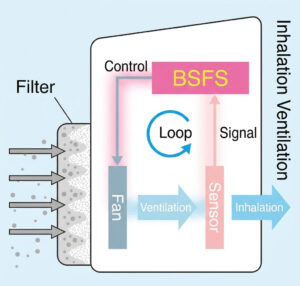
The BL Series is equipped with the Breath Synchronized-Air Flow System (new BSFS), which supplies airflow that closely matches the user’s breathing rhythm better than ever, evolving into a “Highly Synchronized” model.
Breath Synchronized-Air Flow System (BSFS) <HIGHLY SYNCHRONIZED> ELIMINATES THE FEELING OF BREATHLESSNESS/STUFFINESS
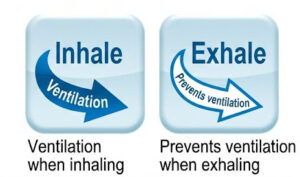
THE BSFS MECHANISM HAS EVOLVED INTO “HIGH SYNCHRONIZATION”
Thanks to a blower fan equipped with a breath detection sensor, the device supplies “the exact adequate amount of airflow needed” corresponding to the wearer’s respiratory volume. Responsiveness to breathing has been enhanced, and the precision in synchronizing with the breathing rhythm has significantly improved.
ENHANCED COMFORT (COMFORT UP)
ELIMINATING MASK DISCOMFORT WITH AIRFLOW THAT CLOSELY FOLLOWS EVERY BREATH
- Reduces the physical workload on workers.
- Resolves difficulty breathing and heat buildup in high-temperature workplaces.
ENHANCED SAFETY (SAFETY UP)
PREVENTING INWARD LEAKAGE WITH HIGH PROTECTION CAPABILITY MAINTAINING POSITIVE PRESSURE CONSTANTLY
Breath Synchronization: Protective performance is ensured by the blower fan operating in sync with breathing.
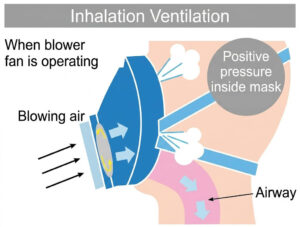 | 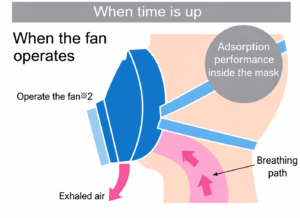 |
DURING INHALATION: When inhaling, the air inside the mask is drawn in, but the supplementary airflow prevents negative pressure (pressure lower than the outside) from occurring. (If a gap occurs, air will blow outwards ※1) ※1: The amount of air blown out varies depending on the fit of the face contact area. | DURING EXHALATION: When exhaling, since there is no factor reducing the internal mask pressure, the supplied airflow is correspondingly reduced. This helps conserve “filter” and “battery” consumption. ※2: Air supply does not completely stop (a minimal amount is maintained for safety). |
PAPR AVOIDS THE INCREASED LEAKAGE RISK CAUSED BY DUST ACCUMULATION IN POORLY FITTING MASKS
FOR CONVENTIONAL DUST MASKS:
As dust accumulates on the filter, inhalation resistance increases, which in turn increases the risk of dust leaking inward during inhalation. Furthermore, the more dust accumulates, even if the gap (mask opening) remains the same, the leakage rate doubles. (See image below)
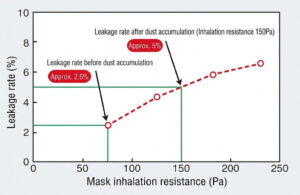
Leakage Rate Measurement Method: An intentional gap is created so that the leakage rate before dust accumulation is approximately 2.5%, then the NaCl concentration inside and outside the mask is measured using a digital dust meter.
ENHANCED ECONOMY (ECO)
PURSUING “ZERO WASTE” WITH AN ECO AIRFLOW MECHANISM THAT MINIMIZES AIR LOSS
Reduces “wasteful dust accumulation” and lowers filter consumption: Minimizes airflow loss to the lowest level, helping to prevent filter clogging.
Limits battery consumption: Extends operation time by reducing battery power consumption during periods of low breathing rates.
COMPARISON OF OPERATING TIME BETWEEN NEW BSFS AND OLD BSFS
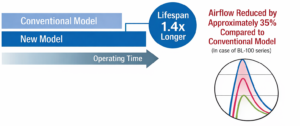
ECO AIRFLOW CREATED FROM HIGH SYNCHRONIZATION
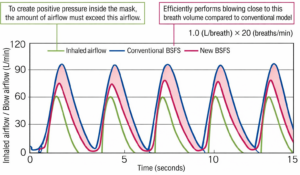 Image showing how BSFS airflow accurately traces the actual breathing waveform.
KOKEN’S LIGHTWEIGHT DESIGN: Minimizing burden even during prolonged work
The “BL Series,” which focuses on optimizing a compact and lightweight design comparable to conventional dust masks, is increasingly being used as a replacement for standard dust masks and is highly rated at various worksites such as tunnel construction, asbestos removal, and arc welding.
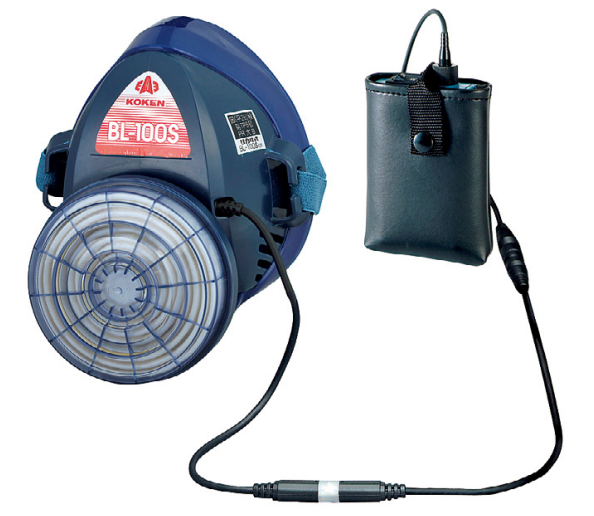
SEPARATE TYPE Because attaching the battery directly would increase weight and put a burden on the neck, the battery is designed as a separate unit to achieve a reduction in weight. This is an ultra-lightweight design with the mask body’s thickness minimized as much as possible.
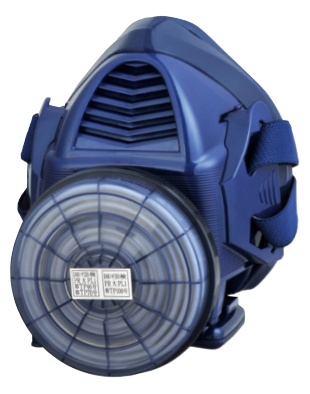
BUILT-IN TYPE Thanks to the “Highly Synchronized” BSFS system minimizing power consumption, the battery size has been significantly reduced. The result is a lightweight design that causes minimal burden to the user, even with the battery integrated inside the mask.
KOKEN’S SAFETY DESIGN: Internal pressure monitoring function maintains positive pressure at all times
(Common for BL-321/BL-351/BL-351X/BL-711/BL-700/BL-200/BL-100 series)
What is essential for today’s worksites is a PAPR capable of “constantly monitoring the internal pressure of the mask and issuing alerts.”
Since a PAPR provides maximum protection when positive pressure is maintained inside the mask, the moment the device can no longer maintain positive pressure is exactly when the filter needs to be replaced. Special attention must be paid to “airflow reduction” caused by increased inhalation resistance as dust accumulates.
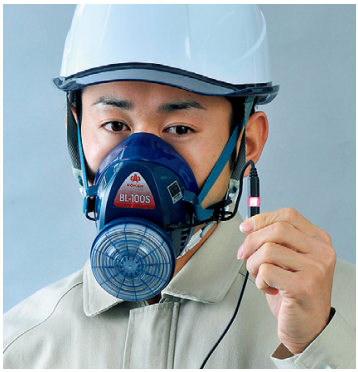
The “Internal Pressure Monitoring Function” notifies you when the internal mask pressure drops due to weakened airflow.
■ Positive pressure inside the mask can be maintained through timely/appropriate filter replacement.
■ Clarifies the standard for filter replacement – which is otherwise often vague or based on subjective estimation.
■ Full airflow can be restored through proper battery charging.
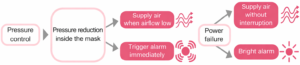
NOTIFICATION VIA AIRFLOW
(Applicable to series: BL-321 / BL-351 / BL-351X / BL-711)
- Alert for internal pressure drop via “Continuous Airflow”: ➔ Please replace the filter.
- Alert for low battery voltage via “Rhythmic Airflow” (intermittent air): ➔ Please replace with a fully charged battery.
NOTIFICATION VIA INDICATOR LIGHT
(Applicable to series: BL-700 / BL-200 / BL-100)
- Alert for internal pressure drop via “Flashing Light”: ➔ Please replace the filter.
- Alert for low battery voltage via “Steady Light” (light stays on without flashing): ➔ Please replace with a fully charged battery.
Gas Cartridges for G-PAPR
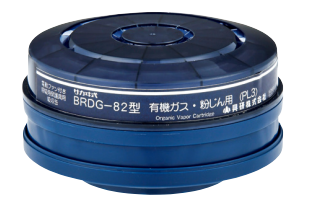
Sakai Type BRDG-82
For Organic Gases / Dust. National Pattern Test Certification No. TP148
PL3
| Decontamination Capacity | Over 50 minutes |
|---|---|
| Particle Collection Efficiency | Over 99.97% (PL3 Classification) |
| Weight (Average Value) | 87g |
| Maximum Use Concentration Limit | 1000ppm (Under 0.1%) |
DANGER
- Never determine cartridge replacement based solely on smell.
- Even if the maximum use time has not elapsed, if you detect a gas odor, experience irritation, or notice an abnormal taste, evacuate immediately to an environment with clean air.
WARNING
For organic gas filter cartridges, please be aware of the following characteristics:
The breakthrough curve is based on test gases specified by National Test Standards or JIS standards, and the effective duration will vary depending on the target gas. Particularly when used for Methanol, Dichloromethane, Carbon Disulfide, Acetone, etc., the effective duration will be significantly shorter than that of the test gas, so it must not be reused and should be replaced after each use.
The effective duration will be shorter in high-temperature or high-humidity environments.
In the case of repeated use over multiple days, the actual effective duration may be shorter than the calculated time, so please establish a maximum use time with an adequate safety margin.
If a cartridge that has been used for more than half its effective duration is stored for 5 days or more, the remaining effective duration may be significantly reduced. In such cases, do not reuse it; replace it with a new one.
- When used against highly toxic dusts such as radioactive materials, asbestos, indium, arsenic, chromium, dioxins, etc., replace the cartridge after each use (single-use only).
- If the filter cartridge contains radioactive materials, dispose of it properly as radioactive waste.
Regarding the maximum use time of the cartridge
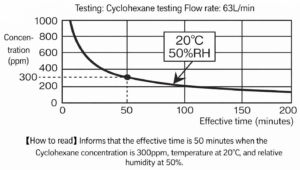
Breakthrough curve of BRDG-82 for Organic Gases / Dust
● Regarding the maximum use time limit
- Measure the gas concentration in the environment beforehand, then refer to the breakthrough curve (graph showing the relationship between gas concentration and effective time) provided in the cartridge’s user manual to calculate the effective duration.
- Use the calculated effective duration as a baseline, and additionally consider the effects of breathing rate (ventilation volume), temperature, and humidity to establish a maximum use time limit that includes a safety margin.
- In cases of repeated short-term use, record each use in the usage record column in the cartridge’s instructions, and manage it so that the total accumulated time does not exceed the maximum use time.
- Please contact us for consultation on how to determine the effective duration for specific toxic gases or under special working conditions.
REQUEST QUOTATION

PAYMENT

LINK