KOKEN LTD.
Koken BL-351 Series P-PAPR
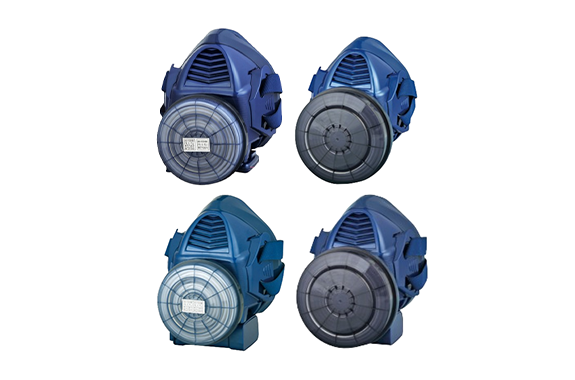
Manufacturer: KOKEN LTD.
Model: BL-351 Series
P-PAPR: Powered Air-Purifying Particulate Respirator
PARTICULATE PAPR and GAS PAPR
- PAPR: Powered Air-Purifying Respirator.
- P-PAPR: Particulate PAPR (Used for dust/particles).
- G-PAPR: Gas PAPR (Used for toxic gases/vapors).
Within the PAPR range, there are “Powered Air-Purifying Particulate Respirators (P-PAPR)” for dust hazards and “Powered Air-Purifying Gas Respirators (G-PAPR)” for toxic gas hazards. It is essential to understand the properties, type, and concentration of the hazardous substances before selecting the appropriate mask.
To prevent inhalation of DUST -> Use a Powered Air-Purifying Particulate Respirator (P-PAPR)
To prevent inhalation of TOXIC GAS -> Use a Powered Air-Purifying Gas Respirator (G-PAPR)
To prevent inhalation of MIXED DUST & TOXIC GAS -> Use a Powered Air-Purifying Gas Respirator (G-PAPR) with dust protection function
Environments where PAPR CANNOT be used
PAPR must not be used if any of the following conditions apply. Please use respiratory protective equipment suitable for the environment, such as a supplied-air respirator or a self-contained breathing apparatus (SCBA).
- Oxygen-deficient environments or those at risk of oxygen deficiency (Oxygen concentration below 18%).
- Cases where the type or concentration of the toxic gas is unknown.
- IDLH environments (Atmospheres Immediately Dangerous to Life or Health).
- Cases where the toxic gas concentration exceeds the permissible limit for the PAPR. ※
- Cases where no filter (canister) is available to remove the specific toxic gas in the environment.
- Cases where a mixture of gases with different properties exists.
- Cases where the environment deviates significantly from normal temperature, humidity, and atmospheric pressure.
(※ According to standards based on the Industrial Safety and Health Act, the application range of G-PAPR is 2% (3% for Ammonia))
SELECTING THE APPROPRIATE PAPR BASED ON HAZARD CONCENTRATION
Determine the Required Protection Factor, then select a PAPR model with an Assigned Protection Factor higher than that value.
Formula: How to calculate the Required Protection Factor
Required Protection Factor = Ambient concentration of identified hazard / Permissible exposure limit of the hazard
Assigned Protection Factor of P-PAPR
| Classification | Facepiece Type | ||||
|---|---|---|---|---|---|
| Leakage Rate | Filter Efficiency | Half-face | Full-face | Hood Type | Face shield |
| Class S | PL3/PS3 | 50/300 | 1000 | 25/1000 | 25/300 |
| PL2/PS2 | — | — | 20 | 20 | |
| PL1/PS1 | — | — | 11 | 11 | |
| Class A | PL3/PS3 | — | — | 20 | 20 |
| PL2/PS2 | 33 | 90 | 20 | 20 | |
| PL1/PS1 | 14 | 19 | 11 | 11 | |
| Class B | PL3/PS3 | — | — | 11 | 11 |
| PL2/PS2 | — | — | 11 | 11 | |
| PL1/PS1 | 14 | 19 | 11 | 11 | |
Assigned Protection Factor of G-PAPR
| Facepiece Type | |||
|---|---|---|---|
| Half-face | Full-face | Hood Type | Face shield |
| 50/300 | 1000 | 25/1000 | 25/300 |
For “G-PAPR with dust protection function,” please refer to the Assigned Protection Factor of P-PAPR (Class S leakage rate) mentioned above for dust (and similar particulates).
TASKS WHERE PAPR USE IS MANDATORY BY REGULATION OR DIRECTIVE
For tasks where PAPR use is mandatory by regulation or directive, please use a PAPR with the designated performance classification.
1. Tunnel Construction Work
Regulation: “Ordinance on Prevention of Pneumoconiosis”
Scope: In tunnel construction, at locations involving “mechanical/powered excavation,” “mechanical loading or unloading of ore/rock,” and “shotcreting.”
PAPR Requirements:
- National test certified product (High airflow type).
- Tight-fitting facepiece type where the battery can be removed for use during blasting operations.
2. Asbestos Removal Work
Regulation: “Ordinance on Prevention of Health Impairment due to Asbestos”
Scope: In asbestos removal tasks, specifically those requiring “Class 1 Asbestos Removal Masks.”
PAPR Requirements: National test certified tight-fitting or hood types (High airflow, Class S, PL3 or PS3).
3. Handling Nanomaterials
Directive: “Regarding Preventive Measures for Exposure to Nanomaterials”
Scope: Manufacturing and handling of nanomaterials. (※)
PAPR Requirements:
- National test certified product (High airflow, PL3 or PS3).
- Shape limitations based on the projected exposure levels of workers.
(※) Depending on the work environment, respiratory protective equipment other than PAPR may be used.
4. Handling Indium
Directive: “Regarding Thorough Health Hazard Prevention Measures for Indium/Tin Oxide Handling”
Scope: Handling of Indium, Tin Oxide, etc. (※)
PAPR Requirements:
- National test certified product (High airflow, PL3 or PS3).
- Limitations on shape and leakage rate based on working environment measurement results.
(※) Depending on environmental results, respiratory protective equipment other than PAPR may be used.
5. Handling Dioxins
Directive: “Revision of Guidelines for Dioxin Exposure Prevention in Waste Incineration Facilities”
Scope: For dioxin-exposure risk tasks classified as “Level 1.” (※)
PAPR Requirements: National test certified product (High airflow, PL3 or PS3).
(※) RL3 or RS3 dust masks may be used, but PAPR with higher protective performance is recommended.
6. Handling Refractory Ceramic Fibers (RCF)
Regulation: “Ordinance on Prevention of Hazards due to Specified Chemical Substances”
Scope: Insulation or fireproofing work involving the application of RCF to furnaces or boilers; or repair, dismantling, and demolition of such furnaces/boilers.
PAPR Requirements: National test certified product (PL3 or PS3).
| PAPR Standards | Beyond JIS standards, Powered Air-Purifying Respirators must adhere to standards defined under the Industrial Safety and Health Act. These comprehensive standards ensure that products are manufactured under strict safety requirements. |
|---|
The following table is excerpted from the ‘Standards for Powered Air-Purifying Respirators’
Types of Powered Air-Purifying Respirators
| Powered Air-Purifying Particulate Respirator (P-PAPR) | |
|---|---|
| Powered Air-Purifying Gas Respirator (G-PAPR) | Type with dust protection function |
| Type without dust protection function | |
■ Classification by Shape
| Tight-fitting Facepiece ・Full-face ・Half-face | Isolation type (with hose) |
|---|---|
| Direct connection type | |
| Loose-fitting Facepiece ・Hood ・Face shield | Isolation type (with hose) |
| Direct connection type |
■ Classification by Performance
| Airflow Performance Classification |
|---|
| Standard airflow type |
| High airflow type |
| Leakage Rate Performance Classification (P-PAPR) |
|---|
| Class B |
| Class A |
| Class S |
| Filter Material Performance Classification (P-PAPR and G-PAPR with dust function) | |
|---|---|
| PS1 | PL1 |
| PS2 | PL2 |
| PS3 | PL3 |
Performance Testing for Powered Air-Purifying Respirators
■ Particle Collection Efficiency Test
(Applies only to P-PAPR and G-PAPR with dust protection)
| Test Particle | Type | NaCl (Sodium Chloride) | DOP (Dioctyl Phthalate) | ||
|---|---|---|---|---|---|
| Particle Size | 0.06μm ~ 0.1μm | 0.15μm ~ 0.25μm | |||
| Concentration | 50mg/m³ or less | 100mg/m³ or less | |||
| Test Flow Rate | Standard Flow | 104 L/min | |||
| High Flow | 138 L/min | ||||
| Collection Efficiency (Continuous measurement; must meet values in the right column) | For NaCl, loaded up to 200mg | For DOP, loaded up to 400mg | |||
| PS1 | 95.0% or more | PL1 | 95.0% or more | ||
| PS2 | 99.0% or more | PL2 | 99.0% or more | ||
| PS3 | 99.97% or more | PL3 | 99.97% or more | ||
■ Canister Testing
(Applies only to G-PAPR)
| Airtightness | No air leakage at 1470 Pa pressure | |||
|---|---|---|---|---|
| Decontamination Capacity (Time until breakthrough at specified concentration must be ≥ the right column) | Type | Test Gas | Breakthrough Concentration | Duration |
| Halogen gas | Chlorine (0.02%) | 1 ppm | 40 mins or more | |
| Organic gas | Cyclohexane (0.03%) | 5 ppm | 50 mins or more | |
| Ammonia | Ammonia (0.1%) | 50 ppm | 40 mins or more | |
| SO₂ gas | Sulfur dioxide (0.03%) | 5 ppm | 35 mins or more | |
| Leakage Concentration | At maximum flow rate, time to reach breakthrough must be ≥ 3 minutes. | |||
■ Inward Leakage Rate Test
| Test Particle | Type | NaCl (Sodium Chloride) | |||
|---|---|---|---|---|---|
| Particle Size | 0.06μm ~ 0.2μm | ||||
| Concentration | 18mg/m³ or less | ||||
| Simulated Breathing | Type | Standard Flow | High Flow | ||
| Waveform | Sine wave | ||||
| Ventilation Volume | 1.5 ± 0.075 L/stroke | 1.6 ± 0.08 L/stroke | |||
| Frequency | 20 times/min | 25 times/min | |||
| Leakage Rate (2-minute continuous measurement; max value must meet the right column) | P-PAPR | Class B | 5.0% or less | ||
| Class A | 1.0% or less | ||||
| Class S | 0.1% or less | ||||
| G-PAPR | 0.1% or less | ||||
| Headform Movement (Calculate leakage rate for each item) | Position and Range | Frequency | |||
| Head | Front/Back 30 degrees | 17 times/min | |||
| Left/Right rotation 50 degrees | 11 times/min | ||||
| Arms | Raising 10 ~ 130 degrees | 7 times/min | |||
■ Other Tests
| Internal Pressure (Tight-fitting only) | Under simulated breathing identical to the leakage test: 0 Pa < Internal Mask Pressure < 400 Pa | |
|---|---|---|
| Minimum Required Flow (Loose-fit only) | Standard Flow | 104 L/min or more |
| High Flow | 138 L/min or more | |
| Inhalation Resistance (Tight-fitting only) | 160 Pa or less (40 L/min flow rate, fan OFF) | |
| Exhalation Resistance (Tight-fitting only) | 80 Pa or less (40 L/min flow rate, fan OFF) | |
| Exhalation Valve Airtightness (Tight-fitting only) | ・Internal pressure must drop immediately when air is sucked. ・Time for pressure to return to normal must be ≥ 15 seconds. | |
| CO2 Concentration Increase (Tight-fitting only) | With fan OFF, headform breathes CO2 air. Difference between wearing and not wearing mask must be < 2.0%. | |
| Noise Level | Noise at the headform ear area must be below 80 dB (both sides). | |
| Flow Rate (G-PAPR only) | Max set average flow | Average must be ≤ the decontamination test flow rate. |
| Maximum flow | Maximum must be ≤ the flow rate set by the manufacturer. | |
| Tight-fitting type | Loose-fitting type | |
| Measure resistance with fan OFF/ON at 20~170 L/min to calculate flow per minute. | With fan ON, draw air for 5 mins to maintain normal pressure in chamber, then measure flow. | |
PAPR USE IS ENCOURAGED IN THE 10TH COMPREHENSIVE DUST HAZARD COUNTERMEASURES
To reduce pneumoconiosis, dust prevention measures must be strengthened.
The “10th Comprehensive Countermeasures for Preventing Dust Hazards” demands the correct use of effective respiratory protection against dust exposure across all industries. PAPR is highlighted as a “more effective preventive measure for health impairment,” and its adoption is highly encouraged.
The use of PAPR is more effective in preventing health impairment compared to standard dust masks due to its higher protection factor and reduced physical strain on the wearer.
(Partial excerpt from the 10th Comprehensive Countermeasures)
Furthermore, due to high performance, PAPR is mandatory for specific tasks, but its use is also recommended for tasks outside the mandatory categories.
While PAPR is mandatory for specific operations under the Dust Rules, its high performance makes it desirable for other tasks; thus, guidance and inspections encourage businesses to adopt PAPR for their workers.
(Partial excerpt from the 10th Comprehensive Countermeasures)
KOKEN BL SERIES BREATH-RESPONSIVE PAPR
Achieving “High Safety” and “Comfortable Fit” as expected
THE EVOLUTION OF THE BL SERIES
The BL Series continues to evolve into the PAPR model that helps perfect safety and health management in every field, aligning with occupational health trends and market expansion.
CORE DEVELOPMENT FOCUS
- “Safety”: Improving the protection capability as a respirator.
- “Flow Technology”: Minimizing waste and improving efficiency.
- “Lightweight Design”: Reducing the burden on the worker.
KOKEN FLOW TECHNOLOGY: New BSFS air flow highly synchronized with breathing
THE MECHANISM OF THE BSFS (BREATH SYNCHRONIZED) SYSTEM
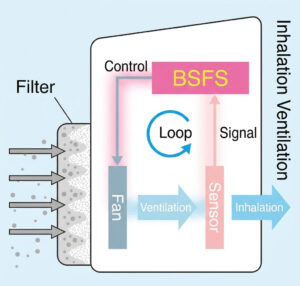
The BL Series is equipped with the Breath Synchronized-Air Flow System (new BSFS), which delivers airflow that follows the breathing rhythm more closely than ever, becoming a “Highly Synchronized” model.
BSFS ELIMINATES THE FEELING OF BREATHLESSNESS/STUFFINESS
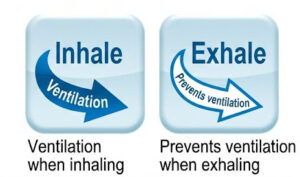
THE BSFS MECHANISM HAS EVOLVED INTO “HIGH SYNCHRONIZATION”
Using a fan equipped with a breath detection sensor, the device supplies “the necessary and sufficient amount of air” corresponding to the user’s inhalation. Responsiveness to breathing has been improved, and the accuracy of synchronization with the respiratory rhythm has significantly increased.
COMFORT UP
SOLVING MASK DISCOMFORT WITH FLOW THAT FOLLOWS EVERY BREATH
- Reduces the physical workload for laborers.
- Solves breathing difficulties and stuffiness in high-temperature workplaces.
SAFETY UP
PREVENTING INWARD LEAKAGE THROUGH HIGH PROTECTION AND CONSTANT POSITIVE PRESSURE
Breath Synchronization: Protection is guaranteed by the blower linked to breathing.
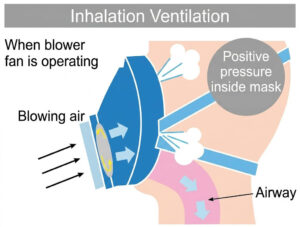 | 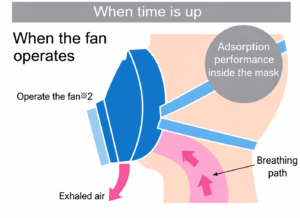 |
DURING INHALATION: Air inside the mask is normally sucked away, but supplemental airflow prevents negative pressure. (If a gap exists, air blows outward ※1) ※1: Airflow varies based on facepiece fit. | DURING EXHALATION: Since pressure doesn’t drop, airflow is reduced. This conserves the “filter” and “battery.” ※2: Flow doesn’t stop completely (maintains a small amount for safety). |
PAPR AVOIDS HIGH LEAKAGE RISKS FROM DUST BUILDUP IN LOOSE MASKS
FOR CONVENTIONAL DUST MASKS:
As dust builds on the filter, inhalation resistance increases, raising the risk of inward leakage. As dust accumulates, even if the gap remains the same, the leakage rate can double. (See diagram below)
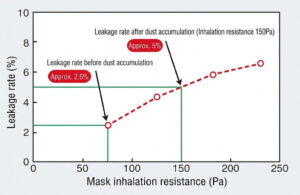
Leakage Measurement Method: A 2.5% gap is created intentionally; NaCl concentration is measured inside/outside the mask with a digital meter.
ECONOMY UP (ECO)
ELIMINATING WASTE THROUGH AN ECO FLOW MECHANISM
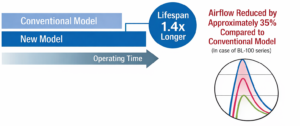
Limits “wasteful dust buildup” and reduces filter usage: Minimizes air loss to reduce clogging.
Limits battery usage: Extends runtime by reducing power consumption during low-respiration phases.
BATTERY RUNTIME COMPARISON: NEW VS OLD BSFS
ECO FLOW CREATED BY HIGH SYNCHRONIZATION
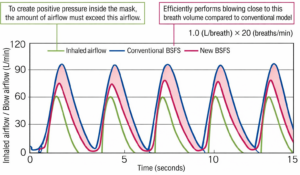 Image of BSFS flow following actual respiratory waveforms with high precision.
KOKEN LIGHTWEIGHT DESIGN: Reducing burden for long shifts
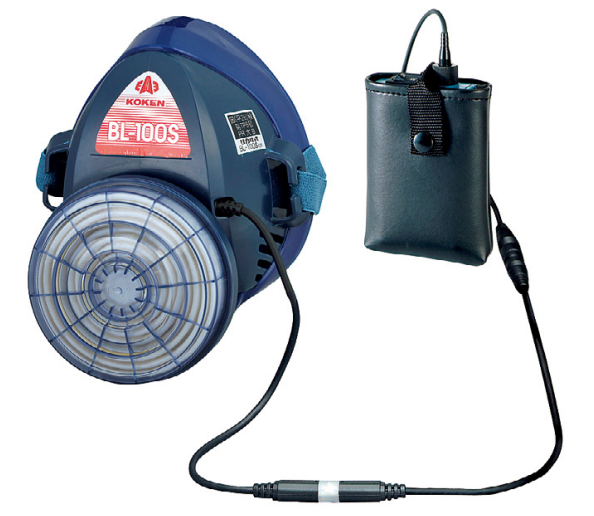
The “BL Series” optimizes compact sizing and weight equivalent to conventional dust masks. It is highly rated in tunnel construction, asbestos handling, and arc welding.
SEPARATE TYPE Because a direct-mounted battery adds weight to the neck, the separate design reduces perceived weight. This ultra-lightweight design minimizes mask body thickness.
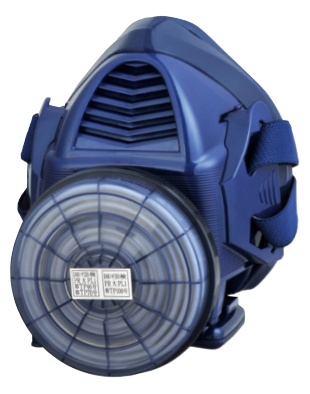
BUILT-IN TYPE Thanks to “High Synchro” BSFS reducing power draw, battery size has been shrunk. This results in a lightweight built-in battery design with minimal burden.
KOKEN SAFETY DESIGN: Internal pressure monitoring to maintain positive pressure
(Common for BL-321/BL-351/BL-351X/BL-711/BL-700/BL-200/BL-100 series)
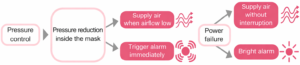
Modern worksites require PAPRs that “constantly monitor internal pressure and provide alerts.”
PAPR is most protective under positive pressure; therefore, the moment positive pressure cannot be maintained is the filter replacement time. “Internal monitoring” notifies the user when pressure drops due to weak flow.
■ Positive pressure inside the mask can be maintained through timely/appropriate filter replacement.
■ Clarifies the standard for filter replacement – which is otherwise often vague or based on subjective estimation.
■ Full airflow can be restored through proper battery charging.
NOTIFICATION VIA AIRFLOW
(For BL-321 / BL-351 / BL-351X / BL-711 series)
- Pressure drop warning via “Continuous Airflow”: ➔ Replace the filter.
- Low battery warning via “Rhythmic Airflow”: ➔ Replace with a charged battery.
LED NOTIFICATION
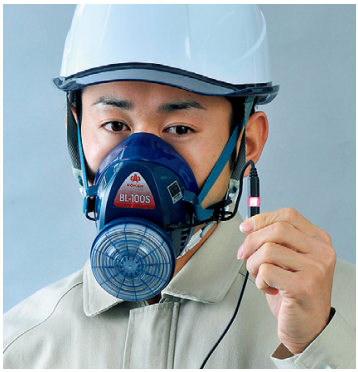
(For BL-700 / BL-200 / BL-100 series)
- Pressure drop warning via “Flashing LED”: ➔ Replace the filter.
- Low battery warning via “Steady LED”: ➔ Replace with a charged battery.
POWERED AIR-PURIFYING PARTICULATE RESPIRATOR (P-PAPR)
BL-351 SERIES
High-duration model, effective for tasks with high dust concentrations
Classification: STANDARD FLOW TYPE
Key Features:
- High Synchro
- Under Chin Design
- Silicone Material
- Speaking Diaphragm
■ High water resistance (IP55 rating) prevents moisture ingress.
■ Integrated “Speaking Diaphragm” for clear communication.
■ “Auto ON/OFF” function: Fan starts automatically upon inhalation.
■ Low battery warning via “Airflow Notification.”
BL-351S, BL-351H, BL-351U
Shared Facepiece Body (※1)
Versatile use by switching filters based on specific application.
- Install BLA-62 for BL-351S configuration
- Install BRD-82 for BL-351H configuration
- Install BRD-82U for BL-351U configuration
Sakai Type BL-351S-04
Includes battery & charger. Pattern Test Cert TP152
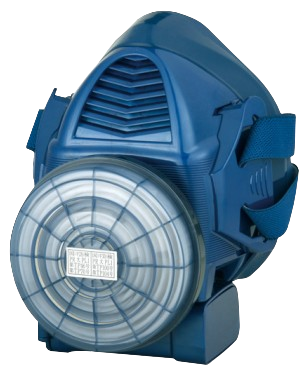
- PL1 efficiency
- Class B leakage
- Assigned Protection Factor: 14
Applications:
- General Dust
- Tunnel Construction Work
Replacement Filter: Alpha Ring Filter BLA-62

Note: BL-351S includes “BL Cover Type 2” to prevent dust accumulation.
Sakai Type BL-351H-04
Includes battery & charger. Pattern Test Cert TP151
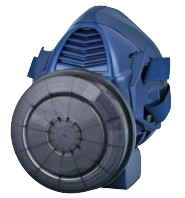
- PL3 efficiency
- Class S leakage
- Assigned Protection Factor: 300 (※2)
Applications:
- Asbestos removal
- Indium handling
- RCF (Refractory Ceramic Fiber) handling
- Dioxin (Level 1)
- Tunnel construction
Replacement Filter: Alpha Ring Filter BRD-82
Sakai Type BL-351U-04
Includes battery & charger. Pattern Test Cert TP153
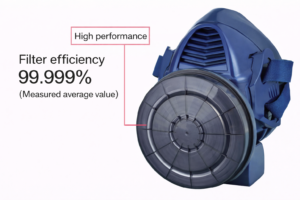
- PL3 efficiency
- Class S leakage
- Assigned Protection Factor: 300 (※2)
Applications: Nanomaterial handling
Replacement Filter: Alpha Ring Filter BRD-82U
Sakai Type BL-351HX-04
Includes battery & charger. Pattern Test Cert TP154
BL351HX
Standard facepiece body.
Compatible with G-PAPR (Gas-PAPR) by installing the appropriate gas canister.
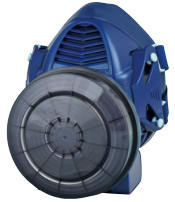
- PL3 efficiency
- Class S leakage
- Assigned Protection Factor: 300 (※2)
Applications:
- Asbestos removal
- Indium handling
- RCF handling
- Dioxin (Level 1)
Replacement Filter: Alpha Ring Filter BRD-82
※1 BL-351HX uses a non-shared facepiece body.
※2 Based on Simulated Workplace Protection Factor (SWPF) measurements conducted by our company, proving the protection factor exceeds 300.
 | Water Ingress Protection (※1), High Waterproofing Enhanced waterproof performance essential for worksites, equivalent to IP55 rating (※2). Designed to protect against water spray from any direction. Suitable for sudden rain or tasks involving water spraying. (※1) Waterproofing is not guaranteed under all usage conditions. |
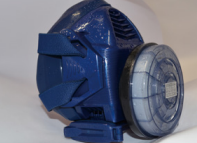
Compatible Series:
- BL-321 Series
- BL-351 Series
- BL-351X Series
Performance Specifications
| Product Name | Classification | Collection Efficiency | Weight (incl. battery) | Facepiece Weight | Battery Specs | Nominal Runtime*1 | Actual Runtime*2 | Fan Lifespan | ||
|---|---|---|---|---|---|---|---|---|---|---|
| Fan Type | Leakage Rate | Filter Grade | ||||||||
| BL-711H | High Airflow | Class S (≤0.1%) | PL3 | 99.97% or more | ≤753g (Avg 723g) | Li-ion Rechargeable Voltage: 7.2V Capacity: 2000mAh Charging: ~3 hours*3 Cycles: ~300 times*3 | Approx. 6 hours | Approx. 6.5–10 hours | Approx. 2,000 hours*3 | |
| BL-711U | 99.99% or more | ≤753g (Avg 720g) | ||||||||
| BL-700HA | 99.97% or more | ≤774g | Avg 591g | Approx. 7.5 hours | Approx. 8–14.5 hours | |||||
| BL-700U | 99.99% or more | |||||||||
| BL-7005/AL | Standard Airflow | Class A (≤1.0%) | PL2 | 99.0% or more | ≤298g (Avg 288g) | Li-ion Rechargeable Voltage: 3.7V Capacity: 1100mAh Charging: ~3 hours*3 Cycles: ~300 times*3 | Approx. 6.7 hours | Approx. 4–9 hours | ||
| BL-1005/AL | PL1 | 95.0% or more | ≤278g (Avg 271g) | Approx. 8.5 hours | Approx. 3.5–11 hours | |||||
| BL-1005X/AL | 95.0% or more | ≤285g (Avg 278g) | ||||||||
| BL-321S | High Airflow | Class B (≤5.0%) | 95.0% or more | ≤252g (Avg 244g) | Approx. 3.5 hours | Approx. 5–9 hours | ||||
| BL-321H | Class S (≤0.1%) | PL3 | 99.97% or more | ≤265g (Avg 257g) | Approx. 3 hours | Approx. 3–6 hours | ||||
| BL-351S | Class B (≤5.0%) | PL1 | 95.0% or more | Avg 315g | Li-ion Rechargeable Voltage: 7.2V Capacity: 2000mAh Charging: ~3 hours*3 Cycles: ~300 times*3 | Approx. 10 hours | Approx. 13–22 hours | |||
| BL-351H | Class S (≤0.1%) | PL3 | 99.97% or more | Avg 328g | Approx. 9 hours | Approx. 8–17 hours | ||||
| BL-351U | 99.99% or more | |||||||||
| BL-351HX | 99.97% or more | Avg 333g | ||||||||
| BL-200S | Class B (≤5.0%) | PL1 | 95.0% or more | ≤395g | Avg 219g | Approx. 10.5 hours | Approx. 12–22 hours | |||
| BL-200H | Class S (≤0.1%) | PL3 | 99.97% or more | ≤409g | Avg 234g | Approx. 9.5 hours | Approx. 10–18 hours | |||
| BL-200U | 99.99% or more | |||||||||
| BL-100S | Class B (≤5.0%) | PL1 | 95.0% or more | ≤383g | Avg 206g | Approx. 10 hours | Approx. 12–22 hours | |||
| BL-100SC | ||||||||||
| BL-100H | Class S (≤0.1%) | PL3 | 99.97% or more | ≤397g | Avg 222g | Approx. 9 hours | Approx. 10–18 hours | |||
| BL-100U | 99.99% or more | |||||||||
Replacement Filters
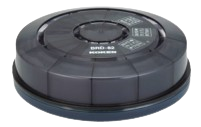 | 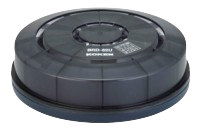 | 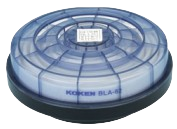 | 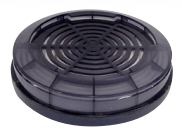 | 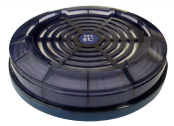 | 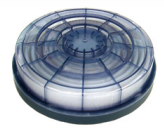 | 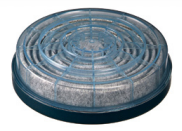 |
| Alpha Ring Filter BRD-82 Screw-on type | Alpha Ring Filter BRD-82U Screw-on type | Alpha Ring Filter BLA-62 Screw-on type | Alpha Ring Filter BRD-7 | Alpha Ring Filter BRD-8U | Alpha Ring Filter BLA-6 | Alpha Ring Filter BLA-6C |
● When performing tasks such as welding or grinding that generate sparks or spatter, it is mandatory to install the dedicated inhalation port cover (sold separately) on the filter (except for the BL-7005 and BL-1005 series). Note that the BL-700HA/U, BL-200H/U, and BL-100H/U series are not designed for use in environments with sparks or spatter.
Features:
- High Synchro: Next-generation model improves airflow efficiency and tracks user breathing rhythm more accurately.
- Fit Checker: Easily perform a fit test by simply pulling the lever.
- Under Chin: Unique curved design enhances the airtight seal at the face contact area.
- Micron: High-performance electrostatic filter. This respirator utilizes Micron filter technology.
- Speaker: Integrated small communication speaker ensures clear dialogue while wearing the mask.
- Special Hard Coating: Improved scratch resistance compared to standard surface hardening methods.
- Silicone: The facepiece uses high-grade silicone material for a soft, skin-friendly fit.
- Speaking Diaphragm: Facilitates clear communication and instruction without mask removal.
- Internal Pressure Monitoring: Flashing light alerts the user when positive pressure is lost inside the facepiece.
- HAWC Lip: Full-face models use the HAWC Lip structure for a high-seal “suction cup effect.”
- Hardened Eyepiece: The visor surface is treated with a hardening process to resist scratches.
REQUEST QUOTATION

PAYMENT

LINK