| Operation | Outline | |
|---|---|---|
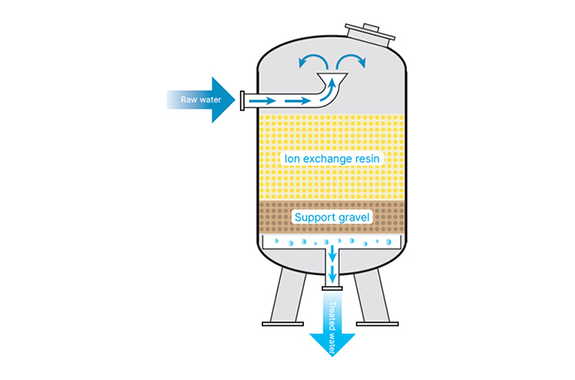
| Liquid flow | Perform water softening (removing hardness object) | |
| Backwash | Loosen the resin. Discharge turbidity captured on the resin surface and in the spaces among resins | |
| Regeneration | Regenerate the hardness removal capacity by flowing brine | |
| Extrusion | Drain the brine (may be collected) | |
| Flushing by water | Completely drain the remaining brine |
ActiResin
The lineup includes both cation exchange resins and anion exchange resins.
Select cationic resin for soft water production.
For pure water production, both types of resins can be used in a mixed bed (one-tower type) or separately (two-tower type).
Mechanism of Ion Exchange
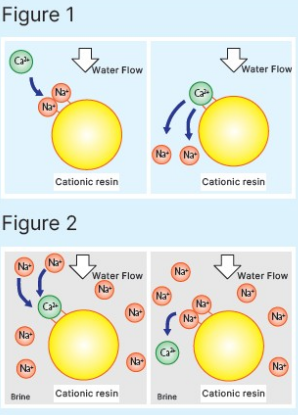
As the name implies, the mechanism of ion exchange involves the exchange of ions in the raw water for ions bound to the functional groups of the ion exchange resin. For example, in the case of cation exchange resins used in water softening, as shown in Figure 1, the sodium ions bound to the resin exchange with calcium and magnesium ions in the raw water, in order to remove hardness.
However, as ion exchange continues, the number of sodium ions bound to the resin decreases, and ion exchange gradually becomes impossible.
In such case, the removed ions, such as calcium ions, are once again exchanged with the initial sodium ions by bringing a large amount of sodium ions into contact. This is called “regeneration” of the ion exchange resin. (Figure 2)